Tools for everyone, fewer failed runs, and worlds you can walk
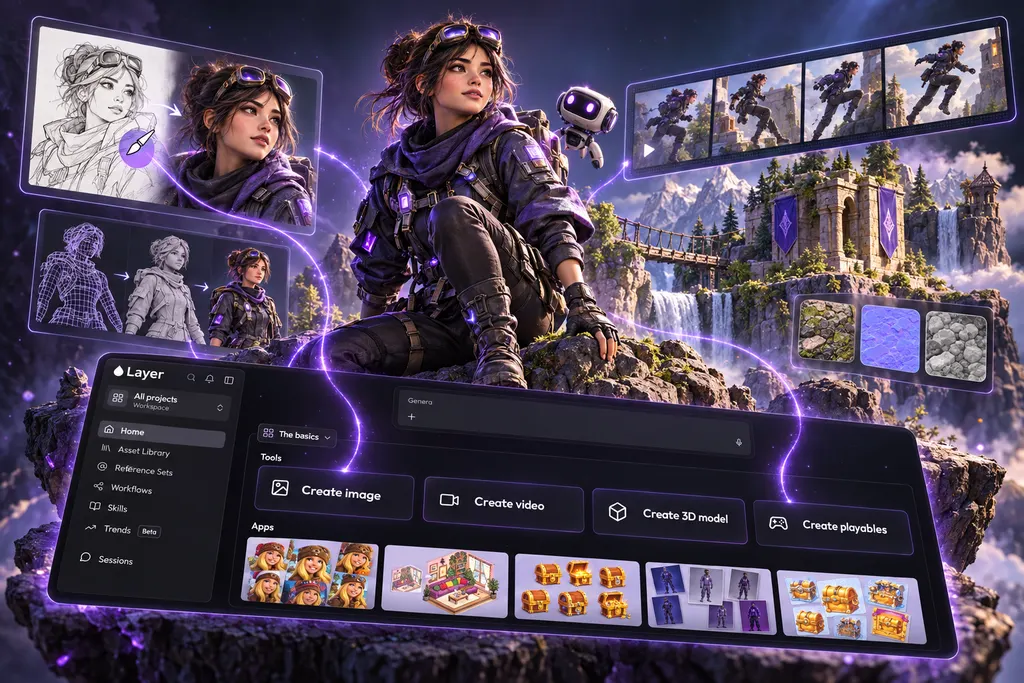
This week the home is a set of tools, for everyone. Image, video, audio, 3D and worlds each have their own form, including the new tools for a single image, video or audio task. Also this week: more than 400 small bugs fixed, a world you can move through, a draft you finish only when the take is right, and the Layer panel in DaVinci Resolve.
What's new?
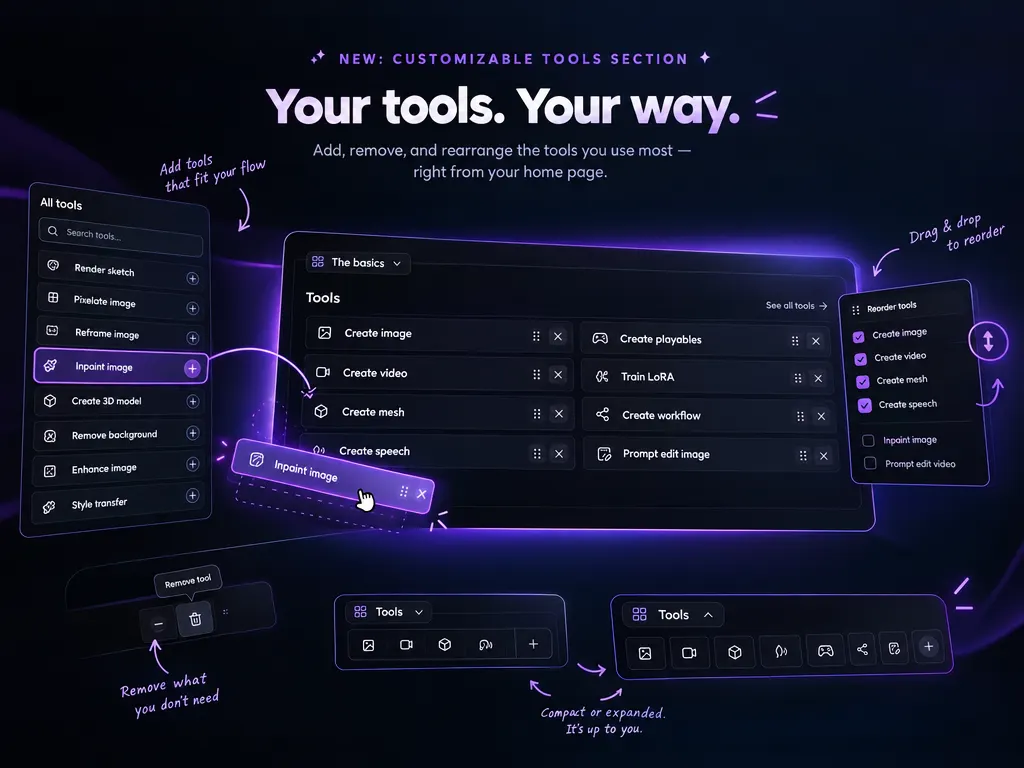
Tools, for everyone: The home is a set of tools. Image, video, audio, 3D and worlds each have their own form, and the form is only for that job. This week's new image, video and audio tools sit in that home: one form per task.
Fewer failed runs: More than 400 small bugs were fixed this week. Fewer rough edges, and fewer runs that fail.
Worlds: Create world builds an explorable space from a prompt, from up to four images of one scene, or from a video. A video is used instead of the images when you give both. Open the result and look around inside it, then capture a view and it lands on the board as an image. Drop a gaussian splat on an upload and it opens as a world too, one object or a whole scene. Draft, on that form, is the cheaper look; finishing it builds the space the preview showed, and the draft does not expire. You can also ask the agent for a world it writes in code.
Drafts: On the video models that offer it, Draft renders a quick preview and spends less. Finish it from the viewer, or from the tile, and you get that take at full quality. Seedance 2.5, including the reference model, previews at 480p and can be finished at 1080p for seven days. FLUX.3, including keyframes and extend, keeps the same motion when you enhance the draft.
DaVinci Resolve: The Layer panel for DaVinci Resolve generates video, images and audio on the timeline you have open, in DaVinci Resolve Studio 19 or later, on macOS and Windows. The signed installer is on the page. Run it, restart, and open Layer from Workspace, Workflow Integrations, Layer AI. A result lands in a Layer bin and on a new track at the playhead. The panel does not change a clip that is already on your timeline.
Change the voice, keep the read: Change voice takes a recording and a voice Reference Set, and says the same words in that voice. A run without a voice set is refused. Isolate voice keeps the voice and drops the music and noise around it. Separate audio pulls one sound out of a mix: a voice, an instrument, or a noise. Extend continues a sound past its end. Restyle turns a sound into another one and keeps the timing.
Edit the clip you already have: Relight moves the light and changes its colour. Dub translates the speech into another language, and the language is a field on the tool. Erase removes an object or a person from every frame. Restyle repaints the clip in another look and keeps the motion. Character swap replaces the people in a clip with reference photos, from one source clip.
The same jobs, as image tools: Restyle repaints an image in another look. Colorize fills line art. Change expression gives a face another expression, and the expression is a field on the tool. Erase removes an object with its shadow and its reflection. Edit text rewrites or removes the words. Translate and remove text are there for store creatives and UI. Pixelate and Create texture are tools of their own.
A brand, from a link: Create a project from a store listing, on the App Store, Google Play or Steam, and Layer reads the game's look into that project: logos, colours, fonts and key art, as Reference Sets, plus a brand book the agent can follow. The project appears first; the brand fills in after. In the setup conversation, pasting a store link, a website or a brand guide (a Canva link works) does the same. A studio site with no published game saves the brand without a project. The card shows what came in, and what a page would not give up.
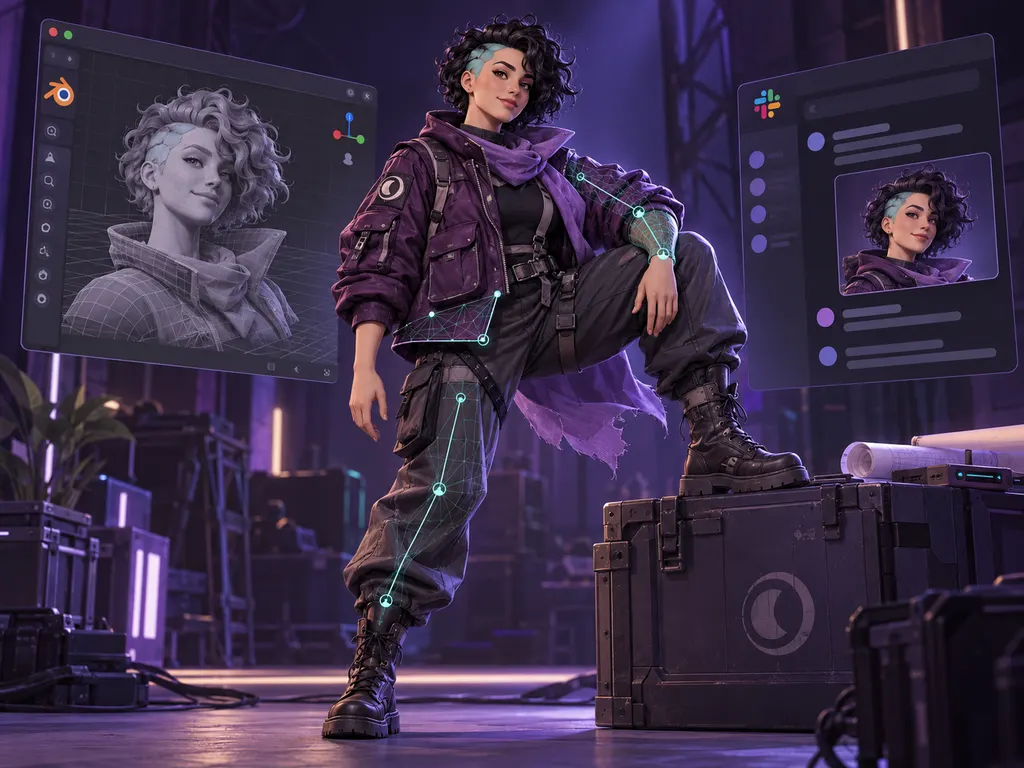
PBR materials, on the mesh: In Blender, Generate PBR materials paints the selection with the maps an engine expects. In the app, the same job runs from a prompt or an image, and the maps travel as a materials archive.
Service accounts: People who can assign roles can create a service account in settings, with its own keys, for automation that should not belong to a person. A new personal access token expires within a year, and one person can hold ten. A SCIM token can live on a Provisioning service account, so the directory keeps working when someone leaves. Microsoft Entra ID can update members, turn them off, and change groups.
Bug fixes & improvements
Settings open from the sidebar. Personal settings and workspace settings are one list, and the sidebar stays open while you are in there.
Integrations, from the sidebar. MCP, the API, and the plugins, each opening in a new tab.
Ask for a mesh or a rig as its own tool, in chat. A game-ready 3D asset goes to a builder that works in Blender: named parts, textures, and a check of its own renders.
The Playables arcade plays a recorded run of each game. The home shelf's video templates each include a generated example.
A playable can show a concept clip of the action before the build, and the art can go through a review before it is locked. One built around a product can end on a shop card, using that product's own images.
Name a download from a file name template.
A workflow stops before the run when the prompt, or a file, is something that model will not take: too short, the wrong kind of media, or a clip shorter than the model allows.
Video uploads can be 100 MB. A model can still refuse a file larger than it accepts. Images and audio stay at 64 MB. OBJ, PLY, STL and FBX uploads come in by extension, and OBJ, PLY and STL are shown as a mesh.
Reference images sit beside the prompt, including on a reframe. Search finds a model by another name it goes by.
On a model's page, Try it runs through the tool that model belongs to, and offers the other tools when the model does more than one job.
The command palette finds tools. An Agent shortcut sits in the header of an open tool.
Help follows the page you are on. Ask how something works and the reply can include the guide, as a card you can open.
The viewer offers the actions that file can take, and a template opens whatever file type it holds.
A large board loads what is on screen. Workflow app outputs stay on that board, in the run's grid. A workflow app can take a batch of inputs, the way a generation form does.
A template's lightbox links the tool and the model, and shows what was attached to the prompt. Your tools menu lists the apps tagged for that view, in at most two rows.
Reference Set categories match the kind of file you are making, and a new set stays in the project you have open. Show all, on Used within, lists every file.
Explore shows a template's cover again. Portrait template videos play wide enough for the tile, and a playable with nothing to show stays off the wall.
A password or passcode sign-in lands in the app. When a model refuses a prompt for safety, the message names the kind of refusal.
Tripo can start from a prompt again. Retired Tripo models are sent to a current one, instead of failing.
Create video can open the reference model for Seedance 2.5 in the edit tool.
A prompt longer than the model accepts is refused, rather than cut short. Every upload surface uses the same size limit for a given kind of file. A generation input that was deleted, or that has no stored bytes, is refused.
The price you were quoted is the price you are billed, including the guidance files and the mask the run actually uses. Style training waits until you pick a base model, and a regenerated caption is reviewed again.
A message you send while a turn is running joins the chat after that turn. Opening Create video no longer swaps in the last edit model you used. A retired model is refused even when a provider is still wired up. Muse Image and Pixverse v6 reach the provider again.
Create template works on playables, worlds, Spine rigs and PBR materials. Saving a session as a template covers every modality, and you can pick the board and the tool. Templates are listed newest first. Auto aspect ratio can pick a size tier, including 2K where the model offers it.
When a tool needs something from you, the agent asks on a card. A Reference Set is refused on a model that can only read it as words in the prompt. A playable export follows each ad network's current spec. MiniMax reference images are fitted to the sizes that model accepts.
New models39
 3D
3DRebuilds a GLB or OBJ mesh with Hunyuan 3D smart topology at a low, medium, or high polygon density.
 Video
VideoKandinsky Lab's lightweight video model, generating 5-second 480p or 1080p clips from text or a still image.
3DRetextures an uploaded 3D model from a text style or a reference image, with optional PBR maps.
3DTripo's newest retopology: rebuilds a high-poly mesh as clean low-poly topology at a target face count, baking the original textures onto the result.
3DRe-unwraps a mesh's UVs with AI-placed seams and packed islands, then remaps its existing textures, rig and animation onto the new layout. Geometry is kept as-is.
 Audio
AudioVocal-free music from a text description.
VideoA formatted lyrics video from an audio track.
AudioSpoken audio from a script, split across built-in voices.
AudioComplete songs with vocals from a description or supplied lyrics.
AudioFull songs and long scores up to six minutes, with restyle, extend and inpaint.
AudioFast, low-cost music up to two minutes, with restyle, extend and inpaint.
AudioFast sound effects with restyle, extend and inpaint.
VideoRemove the people from a clip, leaving the empty set.
 Image
ImageBria's one-shot colorization, trained on licensed data.
VideoDub a clip's speech into another language in the speakers' own voices.
VideoTranslate a clip into another language with re-synced lips.
VideoFaster lip-synced translation of a clip.
ImageBria's eraser for painted areas, trained on licensed data.
ImageLow-cost object removal by name or by painted area.
ImageRemove objects along with their shadows, reflections and lighting.
ImageIdeogram's prompt-free eraser for painted areas.
VideoRemove an object and every interaction it causes in the scene.
ImageGive a face one of twenty named expressions.
ImageChange a face's expression to the one you describe.
VideoRestyle a video from an edited first frame, keeping motion and identity.
ImageSplit a flat graphic into a clean background and live text layers.
VideoEdit outfits, objects or faces in a video from a prompt.
VideoRestyle a video from a prompt, keeping its motion and detail.
VideoRelight a video with MiniMax H3 Max, keeping the source subjects, motion, camera, and audio.
ImageTurn an image into pixel-perfect pixel art.
ImageRemove all the text from an image.
ImageRewrite the text in an image, keeping its typography.
ImageRepaint an image in the style of a reference image.
VideoRecast the people in a video with MiniMax H3 Max, keeping the source motion, camera, cuts, and audio.
VideoUS-hosted Seedance 2.5 with clips up to 30s from text, frames, or references, and native audio.
VideoUS-hosted Seedance 2 with clips up to 15s from text, frames, or references, 480p to 4K, with audio.
ImageRead a texture's base color, normal, roughness, metalness and height maps, packed for any game engine.
ImageTileable PBR materials from a prompt or a photo: texture plus base color, normal, roughness, metalness and height.
ImageGoogle's Nano Banana 2.1 image model for text-to-image and prompt-guided edits.